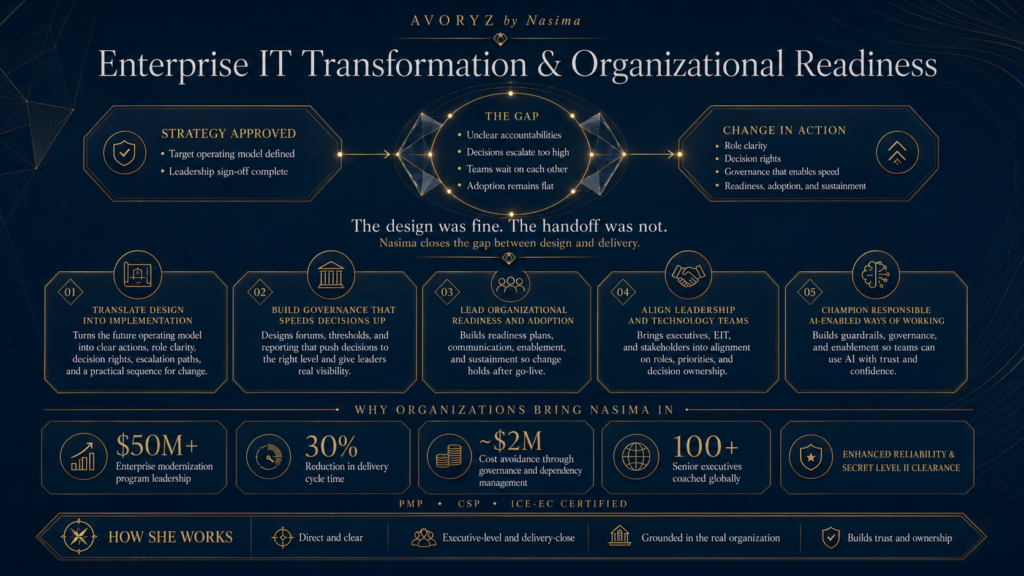
The strategy is signed off. The org chart is drawn. Nothing is moving.
You have the future operating model. Consultants delivered the target state. Leadership approved it.
Six months later, people are still working the old way. Nobody is sure who decides what. Teams are waiting on each other. The executive sponsor is asking why adoption is flat, and the honest answer is that the design was never translated into anything a person could act on Monday morning.
This is the most expensive failure in enterprise transformation, and it almost never gets named. The design was fine. The handoff was not.
Why this happens
Operating model designs are built at the level of boxes and capabilities. Work happens at the level of people, decisions, and habits. Nobody owns the space between them.
So the gap fills with the usual things: unclear accountabilities, competing priorities, decisions escalating three levels higher than they should, technology teams delivering against one plan while the business operates on another, and change communication that announces rather than enables.
The organization is not resisting. It genuinely does not know what to do differently.
Where Nasima works
She closes that gap.
Translating design into implementation. Nasima takes the future operating model and turns it into what changes for whom, in what sequence, with what support — role clarity, decision rights, escalation paths, new ways of working, and the interim states between here and there.
Building governance that speeds decisions up. Most governance slows things down. She designs forums, thresholds, and reporting that push decisions to the right level and give executives real visibility instead of status theatre.
Leading organizational readiness and adoption. Change impact assessment, readiness planning, communication that builds ownership rather than compliance, enablement, and sustainment so the change holds long after go-live.
Aligning executives and technology teams. She brings leadership, enterprise IT, and stakeholder groups into the same room and out of it with agreement on roles, priorities, and who decides what. Then she holds that line when pressure builds.
Championing responsible AI-enabled ways of working. AI adoption fails the same way transformation does: strong tooling, no readiness. Nasima builds the guardrails, governance, and enablement that let teams use AI in ways they trust.
How she works
She starts with the organization you actually have, not the one in the deck — spending the first weeks understanding the strategy, the people, the decision structure, the history, and the constraints nobody writes down.
She is direct. She names the hard things early, because transformations stall when problems stay unspoken and everyone privately knows it. She challenges what needs challenging without dismissing the work that came before her.
She operates at the executive level and stays close enough to delivery to see where work is actually slowing. She does not watch from the sidelines. She works beside leaders and teams, and she takes the outcome seriously.
She sets a high bar. She also builds the trust and ownership that make the new way of working stick, because change that depends on one person’s presence is not change.
Why organizations bring her in
Because she has done this inside regulated environments where the stakes are real.
- $50M+ enterprise modernization program delivered across technology, infrastructure, application development, data, operations, compliance, and vendor teams, impacting 800K+ customers and 1,800+ employees
- 30% reduction in delivery cycle time and approximately $2M in cost avoidance through governance, planning discipline, and dependency management
- Operating models designed and implemented from the ground up, including governance, team structures, decision rights, and executive reporting
- Deep experience across financial services, government, insurance, telecommunications, and enterprise technology
- 100+ senior executives coached globally, because the human layer beneath execution is where transformation succeeds or fails
Government of Canada Enhanced Reliability and Secret Level II clearance. PMP, CSP, ICE-EC certified.